Overview of Containers
Lesson Objectives
- Know what a container is
- Understand why you would want to use a container
In this section, we will introduce what a container is and why you would want to use a container.
What is a Container?
A container is a way to package and run software so that it behaves consistently across different machines.
At a high level, a container bundles:
- Your application
- Its dependencies (libraries, runtimes, tools)
- Its expected filesystem layout (where binaries/configs live)
- Sometimes: environment variables and default execution behaviour
If you’ve ever had “it works on my laptop” problems, containers are designed to reduce that by shipping a self-contained runtime environment.
Containers vs Virtual Machines (VMs)
Containers are often compared to Virtual Machines (VMs):
- Virtual Machine: Packages a full OS + kernel + virtual hardware
- Container: Packages user-space software and libraries, but typically shares the host kernel
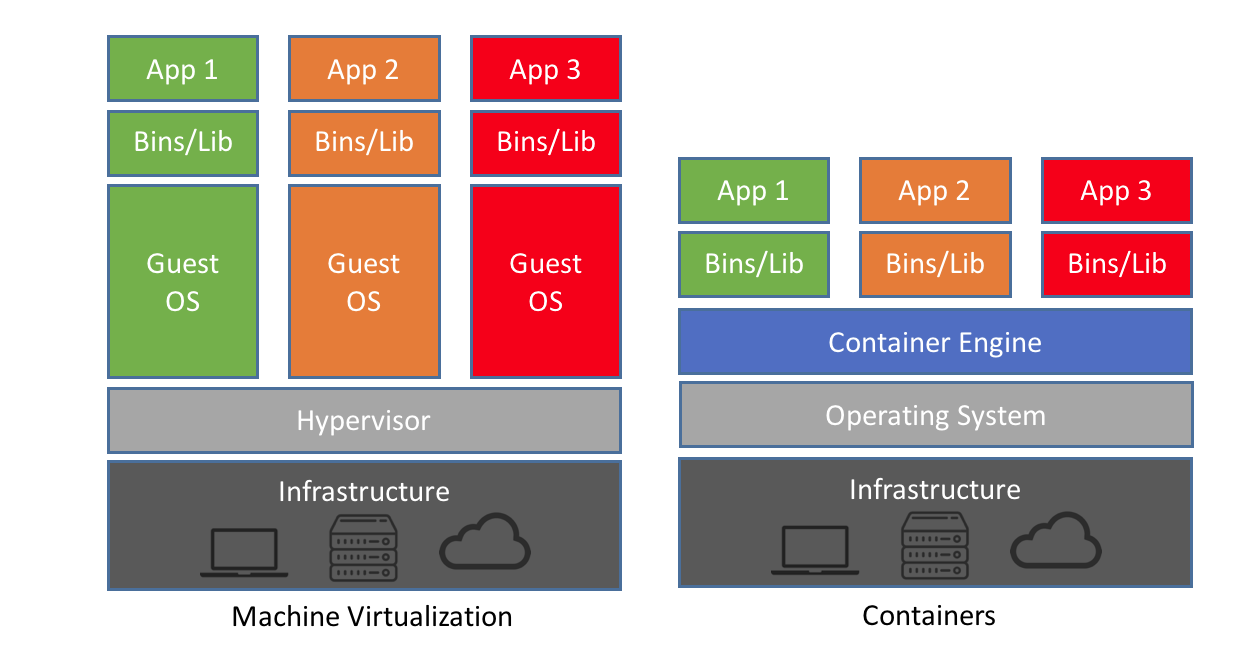
For this reason, containers are usually:
- Lighter weight to run (less CPU and memory usage, faster start-up times)
- Smaller in size (thus easier to transfer and share)
- Modular (possible to combine multiple containers that work together)
Why would you want to use a Container?
The reasons you would want to use a container are:
- Reproducibility: You can define an environment once and run the same software stack elsewhere and get the same results. This is particularly valuable for:
- Scientific workflows
- Published results
- Long-running projects where the “right” environment changes over time
- Portability: You can transfer a container to any computer or HPC and it should generally work without having to go through "dependency hell"
- Some Isolation: The software contained in the container generally sees its own software stack only and will not see software outside the container.
- Dependency Management: Everything you need is installed inside the container.
- No Installation: It is common that installing software on your machine may not work due to missing or different dependencies or for many other reasons. Containers allow the user to just run the software from any (or at least most) machines without hassle.
Keypoints
- Containers are a way to package and run software such that it behaves consistently across different machines
- Containers allow for reproducibility, portability, isolation between software stacks, and dependency management.